
It is the second week of October and the heating calls are starting. A homeowner you serviced in July calls because the furnace smells like burning dust on the first cold morning. You send a tech, he fixes it in forty minutes, and he leaves. That customer paid you once in July and once in October, and in between you were invisible to them. When the AC quits in next year’s heat wave, there is a real chance they call whoever shows up first in the search results instead of you.
That is the hole a maintenance agreement fills. Here is the short answer, up front. An agreement that actually works has three parts: a clear written scope the homeowner understands, a three-tier price where the middle tier is the one you want most people to buy, and an auto-renew engine with a card on file so the plan does not quietly lapse every year. Get those right and you turn one-time calls into a book of recurring revenue that makes your shop worth more and your winters less scary. This post gives you the template, the pricing, the scripts your techs can steal, and the renewal system behind it.
On this page
- Why the agreement is the most valuable thing you sell
- The six parts of an agreement that renews itself
- Part 1: What goes in the written scope
- Part 2: How to price it in three tiers
- Part 3: The enrollment moment and the tech script
- Part 4: Delivery and tracking so visits never get missed
- Part 5: The renewal engine that stops the leak
- Part 6: The compliance you cannot skip
- Three scenarios: solo, 5 techs, 12 techs
- Objections and honest answers
- Frequently asked questions
Why the agreement is the most valuable thing you sell
A break-fix customer pays you when something dies, then disappears. A member pays you every year whether or not anything breaks, calls you first when something does, and books their replacement with you when the system gives out. The agreement is not a loss leader you run to be nice. It is the single asset that changes what your business is.
It also changes what your business is worth. When shops get bought and sold, buyers care most about recurring revenue, because contract income is predictable and sticky in a way demand-only revenue never is. Advisors who broker these deals report that a shop with a strong agreement book sells for a meaningfully higher multiple of earnings than a pure break-fix shop (Lightning Path Partners, 2026). Even if you never sell, every member you add is a small piece of equity, not just this year’s cash.
Pay range from HomeAdvisor (2025); tune-up schedule from ENERGY STAR; setup fee from GoHighLevel’s A2P 10DLC fee schedule.
The reason most shops never see that money is not the offer. It is that the plan is sold inconsistently, written vaguely, and never renewed on purpose. Fix those three and the revenue is just sitting there in the customers you already served.
The six parts of an agreement that renews itself
A maintenance agreement is a system with six moving parts, and a weakness in any one is where members leak out:
- The written scope. What a member gets, in plain language.
- The pricing. Three tiers, built so the middle one wins.
- The enrollment moment. Where you ask, and the exact words.
- Delivery and tracking. Making sure booked visits actually happen.
- The renewal engine. Auto-renew, card on file, reminder sequence.
- The compliance. Consent for the texts, disclosure for the card.
Each part has a predictable way it breaks. I flag the failure mode under each, because that is usually what separates a plan that grows from one that stalls at forty members.
Part 1: What goes in the written scope
The scope is the product. If a homeowner cannot tell you in one sentence what they get, you built confusion, not an agreement. Write it as a short list a sixth-grader could read.
A solid residential single-system scope includes: two precision tune-ups a year (cooling in spring, heating in fall), a standard inspection checklist on each visit, priority dispatch over non-members, a repair discount of 10 to 20 percent, no diagnostic or trip fee on plan visits, and often a standard filter. That spring-and-fall cadence is not something you invented to sell visits. It is the schedule ENERGY STAR publishes, a cooling check in spring, a heating check in fall, and a filter check every month in between.
Put your strongest honest selling line right in the scope: documented annual maintenance keeps the equipment warranty valid. Most major manufacturers can refuse a big parts claim, or void coverage, when the homeowner cannot show proof of yearly professional service with dates and tasks (Next Gen Mechanical; The Furnace Outlet). A member gets that documentation automatically. That reframes the plan from an expense into protection on a $6,000 to $12,000 asset.
Failure mode: vague scope. “Regular maintenance and discounts” means nothing, so the homeowner cannot picture it, does not value it, and does not renew. Spell out the number of visits, the exact discount, and the warranty documentation in writing, and hand them a copy.
Part 2: How to price it in three tiers
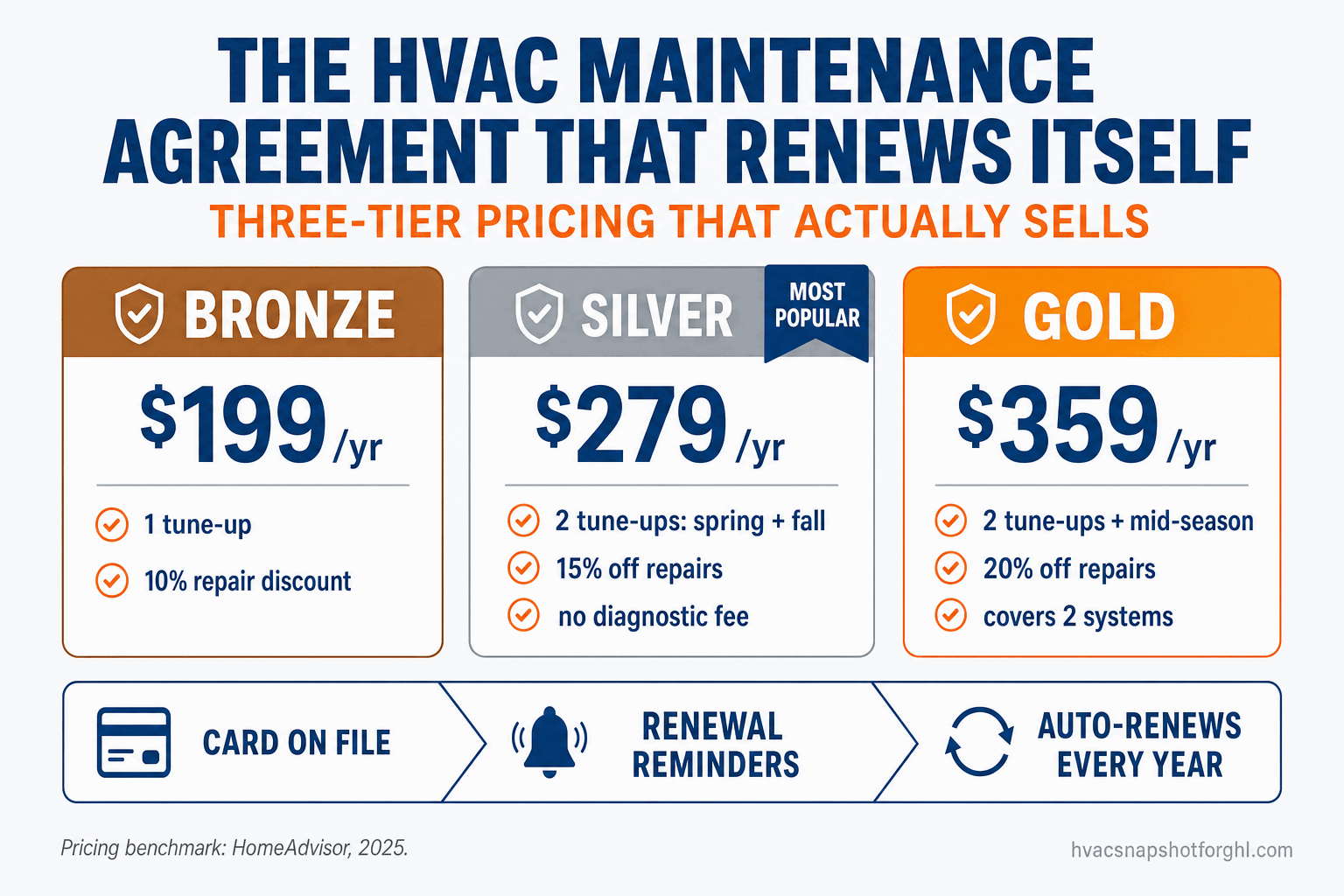
A single price is a yes-or-no decision, and “no” is easy. Three tiers turn the question from “do I want this?” into “which one?” The middle tier becomes the obvious choice, anchored by a cheaper option that looks thin and a premium one that looks like more than most homes need. Built right, the middle tier takes the majority of sales.
Here is a residential structure that works in most markets. Adjust the dollars to your local rates, but keep the shape.
A three-tier residential maintenance plan
| Plan | Bronze | Silver recommended | Gold |
|---|---|---|---|
| Price | $199/yr or $19/mo | $279/yr or $25/mo | $359/yr or $32/mo |
| Feature 1 | 1 tune-up per year | 2 tune-ups (spring + fall) | 2 tune-ups + mid-season check |
| Feature 2 | Standard scheduling | Priority dispatch | Front-of-line dispatch |
| Feature 3 | 10% repair discount | 15% repair discount | 20% repair discount |
| Feature 4 | No diagnostic fee on plan visits | No diagnostic fee, ever | No after-hours fee |
Tier prices benchmarked to published residential plan ranges; homeowners pay roughly $200 to $450 a year per HomeAdvisor (2025). Example terms adapted from the Housecall Pro service-plan template.
Offer monthly billing next to the annual price. “$279 a year” sounds like a bill. “$25 a month, and your spring and fall visits are covered” sounds like nothing. Monthly billing also puts a card on file, which is half of the renewal engine in Part 5.
Failure mode: pricing below your real cost to deliver. If a tune-up costs you $90 in labor and truck time and you sell two plus a discount for $150 a year, you are paying customers to be members. Add up the delivery cost of every tier before you publish the price. The plan should be modestly profitable on its own, with repair and replacement revenue as upside.
Part 3: The enrollment moment and the tech script
Plans are not sold by the office. They are sold by the tech in the mechanical room, right after good work, when the homeowner trusts him. Miss that moment and you chase the sale by phone later at a fraction of the rate.
Techs do not refuse to sell plans. They skip the ask because nobody gave them simple words and a simple reason, and they do not want to feel like a salesman. Give them this.
That leads with the warranty, which takes the pressure off, names concrete visits and a concrete discount, adds light social proof, and asks for the sale with a yes-or-no close while the tech is still on site. Pay a $20 to $40 spiff on every plan a tech enrolls, and post enrollments per tech so the number is visible. What gets measured and paid gets sold.
For customers the tech did not convert, the office follows up the next day.
Failure mode: making enrollment a paperwork chore. If signing up means a form later or a callback during business hours, you lost them. The tech should enroll a member from a tablet in under two minutes, take the card, and have the welcome message fire automatically. Any friction between “yes” and “member” is where plans die.
Disclosure: the link above is our GoHighLevel affiliate link. You pay the same price; we may earn a commission if you start an account through it.
Part 4: Delivery and tracking so visits never get missed
A plan you sell and forget is worse than no plan, because now a member paid for two visits, got none, and will not renew. You need a system that knows which members are due and nudges them to book.
The clean setup tags every member with their tier and two service windows, spring and fall. When a window opens, an automation texts the member to book, offers a couple of times, and drops the visit on the dispatch board. No booking within a week triggers one more nudge, then flags the office to call. The member never has to remember. Your system remembers for them.
Tracking also protects your warranty selling point. Log the date and tasks of every completed visit against the member’s record, so you can produce the documentation manufacturers actually require in seconds. Most shops cannot, which makes you look organized by comparison.
Failure mode: relying on memory and a spreadsheet. Past a few dozen members, manual tracking falls apart, visits slip, and you find out at renewal when members decline. If you do nothing else from this post, build the “who is due this month” view and the automatic booking nudge. It is the same leak our lead-leak audit covers on the new-customer side, pointed at the members you already have.
Part 5: The renewal engine that stops the leak
This is the part almost everyone gets wrong, and it decides whether your book grows or just churns in place. If renewal depends on a member actively choosing to pay again every year, you lose a chunk of them annually to plain forgetfulness. The fix is to make renewal the default and cancellation the choice, with a card already on file.
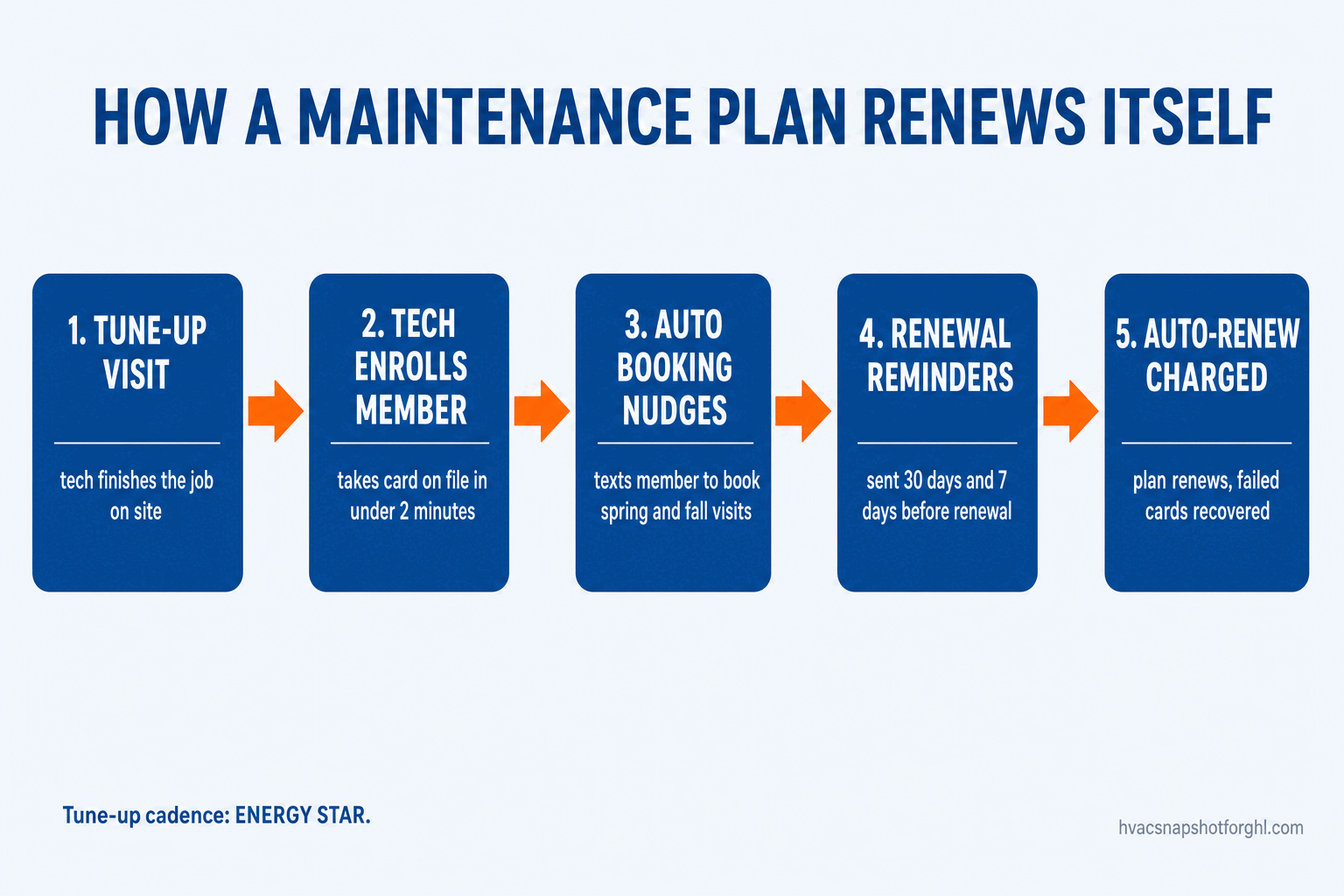
Two pieces do the work. An auto-renew clause: the plan renews each year unless the member cancels, and you charge the card on file. And a reminder sequence before the renewal date, so nobody is surprised, which is both good service and often legally required for card-on-file charges.
That sequence gives honest notice, which keeps the renewal from feeling sneaky, and recovers the failed cards that would otherwise be silent churn. A failed card is the most common reason an engaged member lapses, and one recovery text plus an office call task catches most of them.
Failure mode: auto-renew with no notice. Charging a card with no warning generates chargebacks, angry calls, and the exact trapped feeling you are trying to avoid. Auto-renew is the right default, but only with clear advance reminders and an easy way to cancel. The notice is what makes the default fair.
Part 6: The compliance you cannot skip
Every text above is a message to a consumer, so two rule sets apply. Neither is hard, but skipping them is expensive.
First, consent. Under the TCPA you need the homeowner’s express consent to text them, and you cannot bury it. The clean way is a short line on the agreement and the intake form.
Second, A2P 10DLC registration. To send business texts to US mobile numbers, your number has to be registered. The fees are modest: through GoHighLevel, a one-time setup of about $22.50 for sole-proprietor or low-volume, or $64.00 for high-volume standard, then roughly $1.50 to $10.00 a month per campaign (GoHighLevel, 2026), plus a per-message carrier surcharge of around $0.003 (Twilio). Texting unregistered gets your messages filtered or blocked. We go deeper in the TCPA and 10DLC guide for HVAC.
For the card on file, disclose the auto-renew terms in writing at sign-up: the amount, the renewal date, and how to cancel. That plus the advance reminders is what keeps auto-renew clean.
Failure mode: treating compliance as optional until a complaint arrives. The consent line and registration cost a few dozen dollars and an afternoon. A single TCPA complaint costs far more, and blocked messages quietly kill your renewal engine without you knowing why. Do this part first, not last.
Three scenarios: solo, 5 techs, 12 techs
The framework is the same at every size, but the numbers and the bottleneck change.
Illustrative annual recurring revenue by shop size. Solo: 300 customers, 25% at $249. Mid: 1,500 customers, 30% at $279. Large: 4,000 customers, 35% at $299. Your numbers depend on list size and conversion.
The solo operator. You are the tech, so you are the sales force. Enroll at the truck, take the card on your phone, and let automation handle renewals so you never stop turning wrenches to chase a lapsed member. With 300 past customers and 25 percent conversion at $249, that is about 75 members and $18,675 a year, whether or not July is busy. Your bottleneck is time, so lean on automation for everything except the ask itself.
The 5-tech shop. Now consistency is the problem. Five techs means five enrollment habits, and the plan count only grows if all five ask every time. Pay the spiff, post the per-tech numbers where the crew sees them, and make enrollment a two-minute tablet action. At 1,500 customers and 30 percent at $279, that is 450 members and roughly $125,000 a year, enough to carry payroll through a slow February.
The 12-tech shop. At this size you manage a book, not individual sales. The renewal engine and the “who is due” tracking keep the book from leaking faster than you fill it, and a one-point renewal improvement is real money. At 4,000 customers and 35 percent at $299, that is 1,400 members and over $400,000 in recurring revenue, the number that moves your valuation most when a buyer calls.
Objections and honest answers
“Won’t auto-renew and a card on file make customers feel trapped?” Only if you spring it on them. The trapped feeling comes from a surprise charge, not auto-renew itself. With the 30-day and 7-day reminders, a clear cancellation path, and the disclosure at sign-up, members know exactly what is coming. Done right, auto-renew is the most customer-friendly option, because they never lose coverage or warranty documentation by forgetting a date.
“My techs won’t sell these.” They will when selling is easy and worth their while. Two things fix a non-selling crew: a simple script (Part 3) and a spiff they can see in their paycheck. Techs resist feeling like a salesman and fumbling the words, not the plan. Hand them the words and pay for the yes, and the rate changes within a month. Our guide on selling maintenance plans without sounding pushy has the softer side.
“What if I already run everything in ServiceTitan or Housecall Pro?” Then you have the billing piece, so use it. The gap in most field-service platforms is not billing, it is connected follow-up: the next-day text to non-converts, booking nudges when a window opens, the renewal sequence, and failed-card recovery. If your platform does those well, wire them up there. If not, that automation is what a GoHighLevel build adds on top. Either way the system here is platform-agnostic.
“Is texting renewal reminders even legal?” Yes, with consent and registration, both in Part 6. A renewal notice to an existing customer who gave you their number and agreed to texts is on solid ground. Get the consent line on your forms, register for A2P 10DLC, and keep an opt-out in every message.
Build it once, and it pays every winter
Go back to that October furnace call. The shop with a maintenance agreement does not just fix the furnace and leave. The tech documents the visit, offers the plan with the script, takes the card, and automation handles the rest. That homeowner is now a member who books their spring AC tune-up with you, calls you first when the compressor dies, and renews every year without you lifting a finger. One system, built once, turns the customers you already have into the book that carries you through every slow February.
If you want the membership, auto-renew, reminder sequence, and tracking wired up in a few days instead of built by hand over months, that is what a done-for-you system handles. The pieces are not complicated. They just have to all be connected, and they have to run on their own. If you would rather see it working before you build anything, book a quick demo and we will walk your shop through the whole renewal engine.
Frequently asked questions
What should an HVAC maintenance agreement include?
At minimum: the number of tune-ups per year (two is standard, cooling in spring and heating in fall), the inspection checklist run on each visit, priority dispatch, a repair discount of 10 to 20 percent, no diagnostic fee on plan visits, the warranty-documentation benefit, the price and billing terms, and the auto-renew and cancellation terms. Write it in plain language the homeowner can understand in one read.
How much should I charge for an HVAC maintenance plan?
Homeowners typically pay $200 to $450 a year, per HomeAdvisor. A three-tier structure around $199, $279, and $359 a year works in most markets, with monthly options near $19, $25, and $32. Price each tier so it is modestly profitable to deliver on its own, before counting repair and replacement upside.
How many tune-ups should a maintenance plan include?
Two per year is the standard and recommended cadence: a cooling-system check in spring and a heating-system check in fall, the schedule ENERGY STAR publishes. A premium tier can add a mid-season check, and every plan should remind members to check their air filter monthly.
Should HVAC maintenance plans auto-renew?
Yes. Manual renewal leaks members every year to simple forgetfulness. An auto-renew clause with a card on file keeps the book from draining, as long as you send advance reminders (30 and 7 days out), disclose the terms at sign-up, and make cancellation easy. The notice is what keeps auto-renew fair and chargeback-free.
Is it legal to text customers about plan renewals?
Yes, with two things in place: express written consent collected on your agreement and intake forms (with an opt-out in every message), and A2P 10DLC registration for your business number. Setup runs about $22.50 to $64 one-time plus a few dollars a month. See our TCPA and 10DLC guide for the details.
Why won't my techs sell maintenance plans?
Almost always because they lack a simple script and a reason to bother, not because they refuse. Give them a short enrollment line that leads with the warranty benefit, make enrolling a two-minute action on a tablet, and pay a $20 to $40 spiff per plan with per-tech numbers posted. Enrollment rates climb fast once selling is easy and rewarded.