
It’s 9:40 on a July night in Charlotte, the outdoor unit on a Ballantyne two-story just locked up, and the house is already at 82°F with two kids trying to sleep. The homeowner grabs their phone and starts dialing HVAC shops off Google. Your shop is second on the list. The phone rings four times, rolls to voicemail — “You’ve reached… leave a message” — and they hang up without leaving one. By the time your office opens at 8 a.m., that AC replacement is already scheduled with the shop that picked up. You never knew the call happened. It doesn’t show up in any report. It’s just gone.
Here’s the short version: the biggest revenue leak for most Charlotte HVAC shops isn’t ad spend or pricing — it’s the calls that ring after 5 p.m., on weekends, or during the summer rush when every line is busy and nobody’s at the desk. An AI receptionist is a voice agent that answers every one of those calls 24/7, qualifies the caller, and books the job straight onto your dispatch calendar — so the after-hours emergency becomes your ticket instead of your competitor’s. In a metro adding nearly 290,000 people in five years, with 90°F-plus summers that don’t quit, that leak is expensive. Let’s put real numbers on it.
On this page
- What is an HVAC AI receptionist?
- The after-hours leak: where Charlotte shops lose jobs
- What one missed call is actually worth
- Why Charlotte makes the leak worse
- Speed-to-lead: the job goes to whoever answers first
- The cost of inaction (and why “just add staff” doesn’t fix it)
- How an AI receptionist actually works
- Keeping automated calls and texts compliant
- Frequently asked questions
What is an HVAC AI receptionist?
An HVAC AI receptionist is a voice AI agent that answers your shop’s inbound phone calls automatically — 24 hours a day, including nights, weekends, and overflow during the summer rush — greets the caller in your shop’s name, figures out whether it’s an emergency or routine work, captures the name, address, and problem, and books the job straight onto your calendar or routes it to your on-call tech. It’s the phone equivalent of the front-desk person you wish you could clone: it never sleeps, never takes lunch, and never lets a call roll to voicemail.
That last part is the whole point. Most shops don’t lose calls because they’re bad at answering — they lose them because a human can only answer one call at a time, during the hours they’re at the desk. The no-cool call at 9 p.m., the third caller who hits a busy line during a July heat spell, the Sunday-morning “my furnace won’t light” — those are the calls that leak. The AI caller in our snapshot exists to catch exactly those, so a booked dispatch board replaces a list of missed-call notifications.
The after-hours leak: where Charlotte shops lose jobs
Walk through a normal week and the leak shows up in three predictable places:
- After hours. The office closes at 5, but the AC doesn’t care what time it is. Emergency no-cool and no-heat calls cluster in the evenings and on weekends, precisely when a homeowner has been home long enough to notice the house won’t hold temperature. If those calls hit voicemail, most people don’t leave a message — they dial the next shop.
- Overflow during the rush. On a 95°F Charlotte afternoon your phone doesn’t ring once at a time; it rings in bursts. While your one office person is booking caller #1, callers #2 and #3 get a busy tone or voicemail. Those aren’t bad leads — they’re jobs you already paid Google or Facebook to generate, lost at the last inch.
- The weekend. Saturday and Sunday are when homeowners are home to notice a problem and have time to deal with it. A shop that’s dark all weekend is dark during some of the highest-intent hours of the week.
None of these show up as a line item, which is why they’re so easy to ignore. There’s no “missed revenue” row in your P&L. But every one of those unanswered rings is a homeowner who chose to call you and got nothing back. That’s not a cold lead — it’s a warm one you dropped.
I ran a dispatch desk for years, and the calls that hurt most were never the ones we quoted and lost. They were the ones we never heard ring — 9 p.m., 7 a.m., the third line during a heat wave. You can’t win a job you didn’t know existed.
What one missed call is actually worth
The reason this leak matters isn’t the count of missed calls — it’s the dollar value behind each one. HVAC isn’t a $30 impulse purchase. A single inbound “my AC quit” call in a Charlotte July can be anything from a service diagnostic to a five-figure system replacement.
Using current marketplace data, here’s the ladder a missed call falls somewhere on:
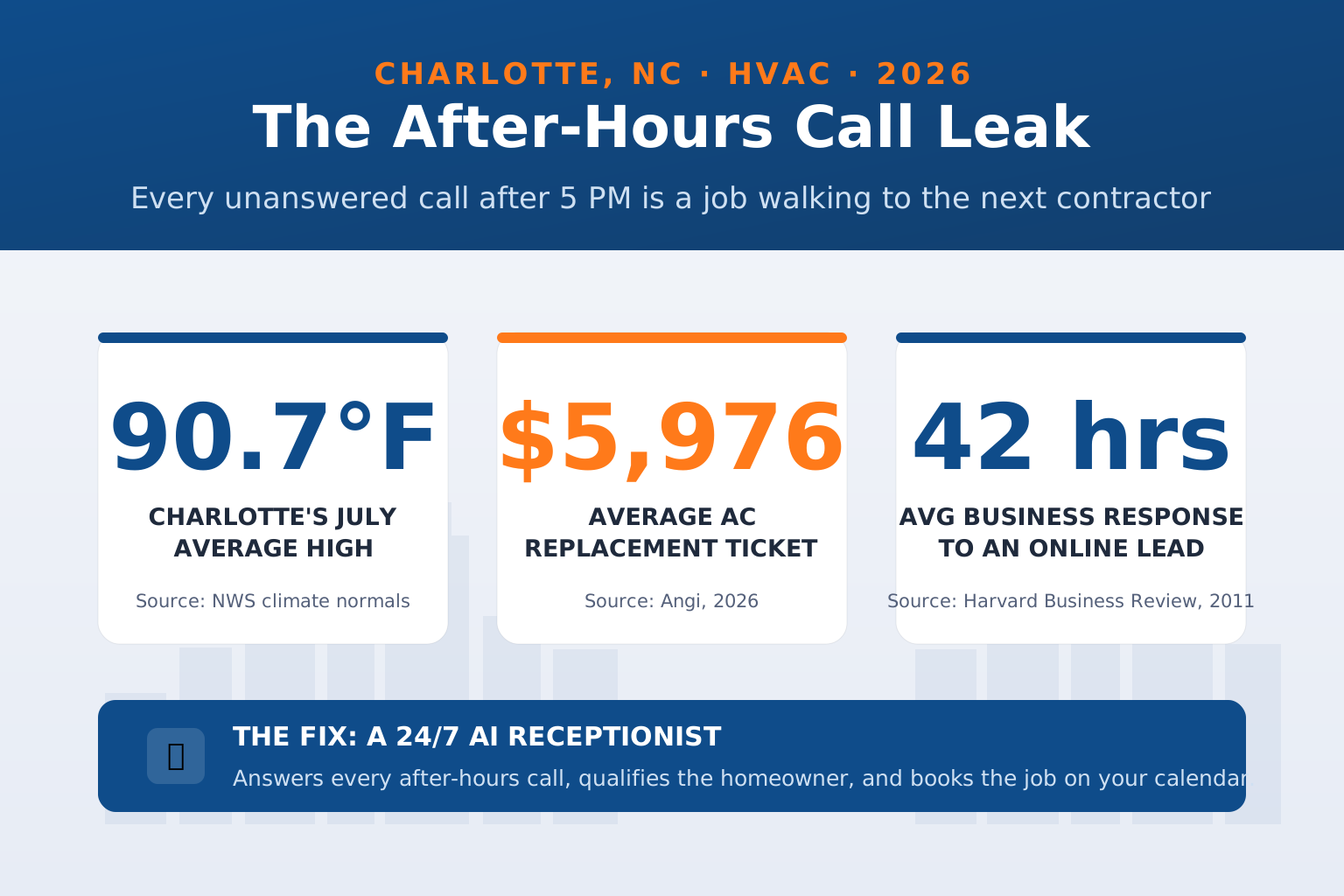
The average HVAC repair runs about $350, an AC repair lands anywhere from $450 to well over $2,000, and a full AC replacement averages $5,976 nationally, with a typical range of $3,887 to $8,072 (Angi, 2026). Now do the math on a single busy weekend. If your shop misses even two after-hours no-cool calls a week during peak season and just one of them was a replacement, that’s roughly $6,000 in one job you never quoted — every week the leak is open. Against that, the monthly cost of an always-on responder isn’t an expense; it’s the cheapest job insurance you can buy.
Why Charlotte makes the leak worse
Two things about the Charlotte market turn a manageable leak into a real problem.
First, demand is growing fast. Metro Charlotte added 289,331 residents between 2020 and 2025, making it the 5th-fastest-growing large metro in the country by numeric growth, with Mecklenburg County ranking 7th among all U.S. counties (UNC Charlotte Urban Institute, 2026; Axios Charlotte, 2026). The city itself sits around 943,000 people (U.S. Census QuickFacts, 2024). More households means more systems that will eventually fail — and more competitors chasing the same calls. When every shop’s Google listing looks similar, the tiebreaker isn’t your workmanship. The homeowner hasn’t seen it yet. The tiebreaker is who answers.
Second, the climate keeps the phone ringing. Charlotte has a humid-subtropical climate where July averages a 90.7°F high and summer humidity hovers around 70% (Current Results / NWS normals), accumulating roughly 1,767 cooling degree days a year (NWS Charlotte climate normals). That’s a heavy-cooling market: air conditioners run hard for months, and hard-run equipment fails — usually on the hottest day, often after hours. The busier the season, the more calls stack up beyond what one desk can answer. Charlotte doesn’t give you a slow month to catch your breath; it gives you a peak that overwhelms manual coverage.
Put together, Charlotte is a growing, hot, competitive market where the volume of after-hours and overflow calls is exactly the volume a human desk can’t keep up with. That’s the definition of a leak worth plugging.
Speed-to-lead: the job goes to whoever answers first
Everything above comes down to one well-documented principle: in service businesses, the first shop to respond usually wins the job. The landmark data comes from Dr. James Oldroyd’s MIT-affiliated Lead Response Management study, which analyzed more than 15,000 leads and 100,000 call attempts: a lead contacted within 5 minutes is 21× more likely to qualify than one contacted at 30 minutes, and you’re 100× more likely to even make contact (MIT / Lead Response Management, 2007).
That study was about web-form leads, but the phone version is even more brutal, because a caller isn’t filling out a form to be contacted later — they want an answer now. When Harvard Business Review audited 2,241 U.S. firms, the average business took 42 hours to respond to an online lead, 24% took more than a day, and 23% never responded at all (HBR, 2011). Firms that reached a lead within an hour were about 7× more likely to qualify it than those that waited even one more hour. A voicemail box at 9 p.m. is the phone equivalent of that 42-hour delay — and the homeowner with a hot house isn’t waiting 42 hours. They’re calling the next shop before you finish your coffee.
No human answers every call inside five minutes at 2 a.m. It’s not a discipline problem; it’s a physics problem. An AI receptionist is how you hit that window every single time. It’s the phone-side sibling of the speed-to-lead system every fast-growing shop is now building, and it closes the same gap that booking by phone leaves wide open.
The cost of inaction (and why “just add staff” doesn’t fix it)
The obvious reaction is “we’ll just have someone cover the phones.” Here’s why that rarely works — and what it actually costs:
- Hiring a night/weekend front-desk person is expensive and hard to justify. HVAC labor isn’t cheap or easy to find; nationally, the median HVACR wage is $59,810 and the field is projected to grow 8% through 2034 (BLS, 2024). Paying someone to sit and wait for after-hours calls that come in bursts is dead payroll most of the night.
- An answering service is better, but limited. Traditional live answering services run about $135–$400/month, and high-volume plans can top $2,900/month (Housecall Pro, 2026). They take a message — but a generic operator who doesn’t know your service area, your pricing, or your calendar usually can’t book the job. You still wake up to a callback list, and by then the homeowner has moved on. We break down that trade-off in AI receptionist vs. answering service.
- Doing nothing has the highest cost of all. It’s just invisible. Every open week of the leak is more $350-to-$5,976 tickets (Angi, 2026) handed to whoever answered. It’s the after-hours missed-call problem compounding quietly, month after month.
The math is lopsided. The tickets you save by catching a handful of after-hours calls dwarf the cost of the system that catches them — which is why an AI receptionist pays for itself faster than almost any other automation a Charlotte shop can add.
How an AI receptionist actually works
The fix is to take the “answer every call instantly, at any hour” job off your team entirely and hand it to a voice agent that lives on your phone line. Here’s the flow the AI caller in our snapshot runs:
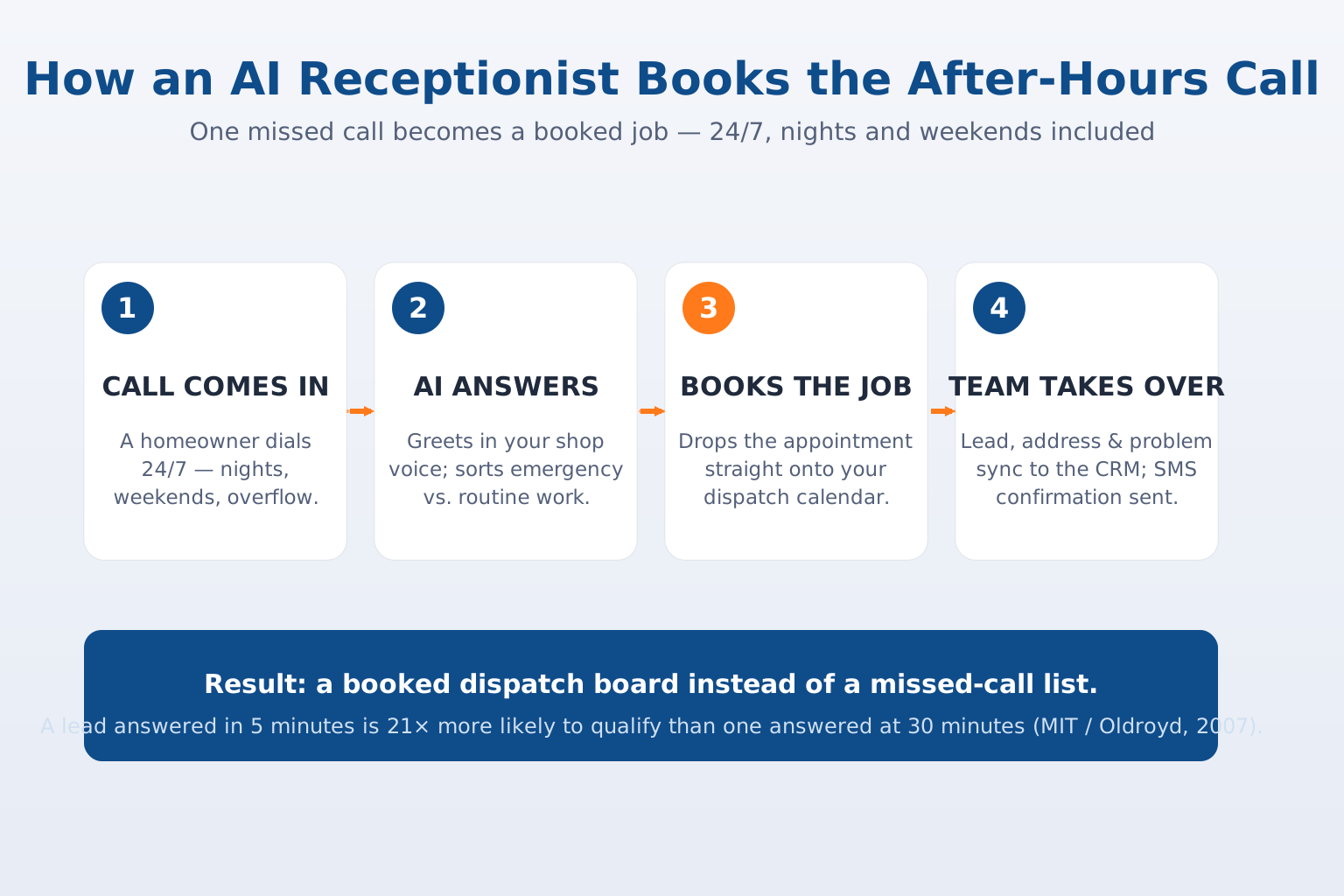
- The call comes in. A homeowner dials your shop — at 9 p.m., on a Sunday, or as the third caller during a heat spell. Instead of ringing into voicemail or a busy tone, the AI receptionist picks up on the first ring, every time.
- The AI answers and qualifies. It greets the caller in your shop’s name and voice, then works the lead: Is this an emergency no-cool or a routine tune-up? What’s the address and service area? What’s actually wrong? It sounds like a competent front-desk person, not a phone tree.
- It books the job. When the caller is ready, the agent offers real open slots and drops the appointment straight onto your dispatch calendar — or, for true emergencies, routes the call to your on-call tech. No phone tag, no “someone will call you back.”
- Your team takes over warm. The caller’s name, address, phone, and the nature of the problem sync to your CRM, and the homeowner gets an SMS confirmation. Your office opens to a booked board instead of a list of missed calls.
Pair it with the AI chatbot on your website and automated appointment reminders, and the same instant-answer coverage extends from the phone to your site and your follow-up — so no channel, and no hour, goes cold. It’s the same always-on system that helps shops handle the summer call rush without dropping jobs.
A Charlotte HVAC shop's phone line, before and after an AI receptionist
After-hours and weekend calls roll to voicemail — and most homeowners don't leave one, they dial the next shop. Overflow calls during a July heat spell hit a busy tone. The office opens to a list of missed-call notifications with no name and no way to win the job back. The leak never shows up in a report.
Every call is answered on the first ring, day or night, in your shop's voice. Emergencies are triaged and routed; routine jobs are booked onto the calendar automatically. The homeowner gets an SMS confirmation, and your team opens to a booked board with warm, tagged leads in the CRM — the after-hours jobs you used to lose stay yours.
Keeping automated calls and texts compliant
Answering calls with AI and following up by text means playing by the messaging rules, and this is where a done-for-you setup earns its keep. The moment an automated conversation moves a homeowner into SMS — a booking confirmation, a reminder, a follow-up — you’re in TCPA and 10DLC territory: you need proper consent, clear opt-out handling (“reply STOP”), and a registered 10DLC campaign for business texting. A sloppy DIY automation that texts without consent is a compliance problem, not a growth strategy.
The right approach captures consent inside the call flow, keeps the audit trail, and only texts homeowners who opted in — handled by the workflow, not left to memory. We lay out the specifics in the HVAC TCPA & 10DLC guide and the AI receptionist compliance rules, and compliant messaging is wired into our snapshot from day one. Done right, you get the speed of automation without the regulatory exposure.
What it’s worth to a Charlotte shop
Put the pieces together and the return is hard to argue with. Every after-hours and overflow call is a lead you already earned — a homeowner who searched, found you, and dialed. An AI receptionist makes sure each one gets answered inside the window that actually converts, at every hour, in a fast-growing, heat-driven market where the next shop is one ring away. It captures the job, feeds your CRM a warm lead, and hands your team a booked board instead of a missed-call list.
The alternative isn’t “a few missed messages.” It’s someone else booking the Charlotte jobs you were already in the running for — decided by nothing more than who picked up. The shop that answers every call isn’t working harder than you. It just built the system once and let it answer the phone, day and night, so it never loses a $6,000 replacement to a voicemail box again.
Frequently asked questions
HVAC AI receptionist for Charlotte shops — common questions
What is an HVAC AI receptionist?
It's a voice AI agent that answers your shop's inbound phone calls 24/7 — including nights, weekends, and overflow during the summer rush — greets the caller in your shop's name, determines whether it's an emergency or routine work, captures the name, address, and problem, and books the job onto your dispatch calendar or routes it to an on-call tech. It catches the after-hours and overflow calls a human desk can't, so they become your tickets instead of a competitor's.
Why do missed calls cost Charlotte HVAC shops so much?
Because each call is a real, high-value ticket and the job goes to whoever answers first. In 2026 an HVAC repair averages about $350, an AC repair runs $450–$2,000+, and a full AC replacement averages $5,976 (Angi). A lead contacted within 5 minutes is 21× more likely to qualify than one contacted at 30 minutes (MIT/Oldroyd, 2007), and the average business takes 42 hours to respond to an online lead (HBR, 2011). A voicemail box at 9 p.m. hands that ticket to the next shop.
Isn't an answering service the same thing?
Not quite. A traditional live answering service (about $135–$400/month per Housecall Pro) usually just takes a message — a generic operator who doesn't know your service area, pricing, or calendar can't actually book the job. You still wake up to a callback list, and by then the homeowner has moved on. An AI receptionist qualifies and books the appointment in the moment. See our full breakdown in 'AI Receptionist vs Answering Service for HVAC.'
Will an AI receptionist sound robotic to my customers?
Good voice AI is configured in your shop's name and voice and handles the routine, repeatable parts of a call — service area, urgency, availability, booking — conversationally. Homeowners with a hot house overwhelmingly prefer a fast, competent answer at 9 p.m. to a voicemail box and a callback the next afternoon. True emergencies can be routed straight to your on-call tech.
Is an automated calling and texting system TCPA-compliant?
It can and must be. Once an automated conversation moves a homeowner into SMS follow-up, you need TCPA-compliant consent, opt-out handling ('reply STOP'), and a registered 10DLC campaign. A done-for-you setup captures consent inside the call flow and only texts homeowners who opted in. See our HVAC TCPA & 10DLC guide and AI receptionist compliance rules for the details.
Does this only help shops in Charlotte?
No. It works for any residential or light-commercial HVAC contractor in the U.S. or Canada — Charlotte is just a clear example of a fast-growing, heat-driven, competitive market where answering first is the whole edge. The AI caller is part of our complete HVAC snapshot, which installs into your GoHighLevel account in about 24 hours.
About the author
Tony Escalante is an HVAC Operations & Dispatch Strategist based in Phoenix, AZ. He spent a decade running the dispatch desk and service board for a multi-truck residential cooling shop before moving into systems work. He writes about turning chaotic summer call volume into bookable, trackable jobs — and why the phone, not the wrench, is where most HVAC revenue leaks.
Related posts
- After-Hours Missed Calls Are Costing HVAC Shops $40K+/Year
- AI Receptionist vs Answering Service for HVAC
- Speed to Lead for HVAC: Why the First 5 Minutes Decide Who Wins the Job
- How HVAC Shops Handle the Summer Call Rush Without Dropping Jobs
- Is Your HVAC AI Receptionist TCPA-Compliant? The 2026 Rules