
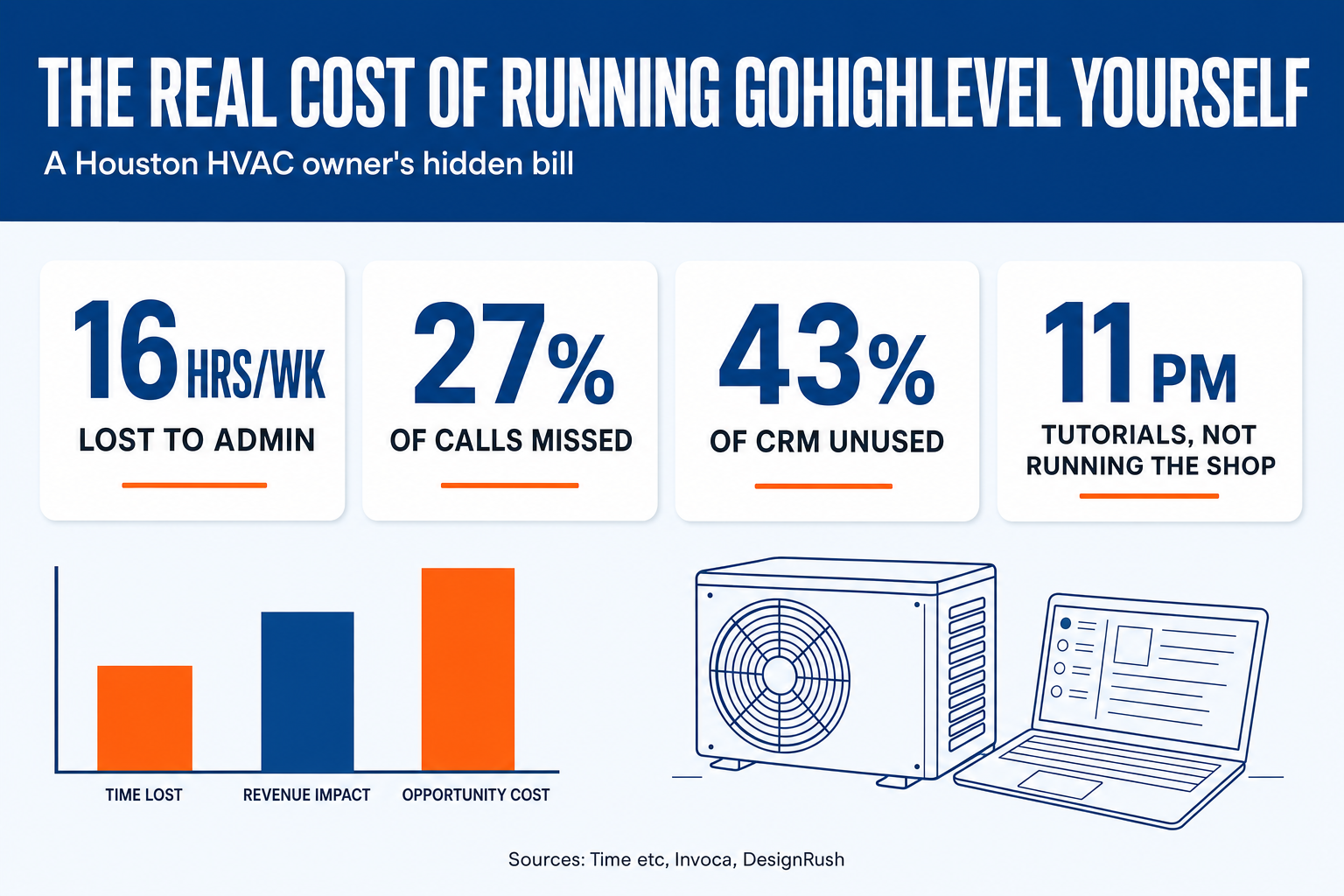
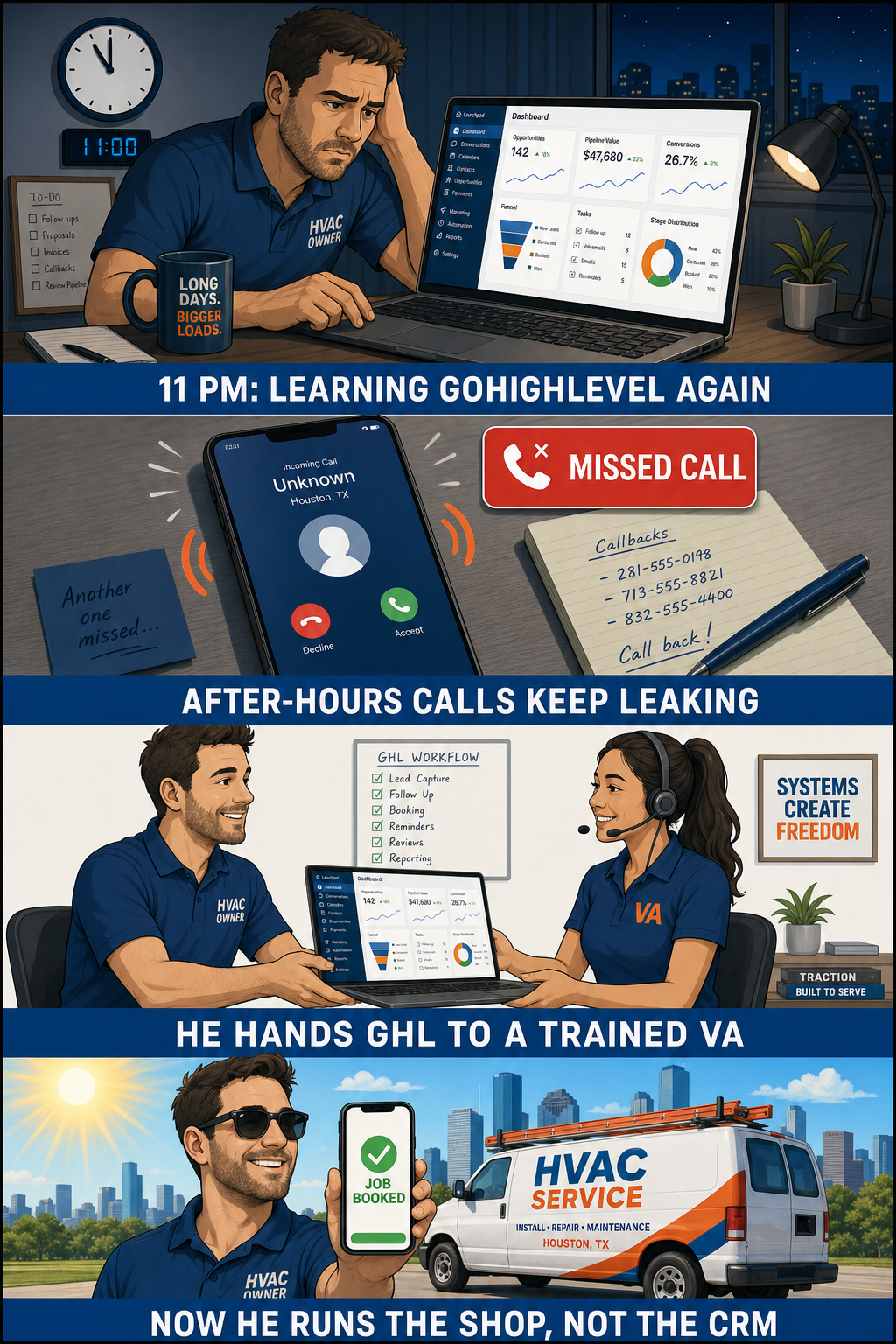
It’s 11:14 PM in a house off the Sam Houston Tollway. The trucks are parked, the last no-cool call of the day got booked hours ago, and the owner of a three-truck Houston HVAC shop is exactly where he ends up most nights: hunched over a laptop, watching a GoHighLevel tutorial with a lukewarm coffee, trying to figure out why his missed-call text-back stopped firing. He didn’t get into HVAC to become a CRM admin. But the software he bought to save time has quietly become a second unpaid job — and while he’s buried in workflow settings, the thing he’s actually good at, running a shop that captures every install Houston’s heat throws at it, sits untouched.
That’s the trap this article is about. Here’s the short version: the real cost of running GoHighLevel yourself isn’t the $97-$497 monthly subscription — it’s the 15-plus hours a week you burn learning and babysitting the platform instead of running the business, the automations you never finish building, and the jobs that leak out the side while you’re stuck in settings. For most Houston HVAC owners, handing GHL to a trained GoHighLevel VA costs less than the revenue a single missed install would have covered — and buys back the one thing you can’t purchase more of. Let’s break down where the money actually goes.
On this page
- What does it actually cost to run GoHighLevel yourself?
- The five hidden costs Houston HVAC owners never put on the invoice
- Why HVAC is a uniquely bad fit for the DIY-GHL owner
- What a GHL VA actually does for a Houston HVAC shop
- DIY GoHighLevel vs hiring a GHL VA: the honest comparison
- What a GHL VA costs — and when it pays back
- FAQ
What does it actually cost to run GoHighLevel yourself?
Ask a Houston HVAC owner what GoHighLevel costs and he’ll quote you the subscription — $97 on Starter, $297 on Unlimited. That number is real, and it’s also the least important cost on the page. GoHighLevel is a deep platform: pipelines, triggers, workflows, calendars, forms, Twilio and 10DLC setup, AI chat and voice, review requests, reporting. It can run an entire HVAC back office. But only if someone configures it and keeps it running — and that someone is usually the owner, working nights, learning as he goes.
The real cost of DIY GoHighLevel is the owner’s time priced at owner’s rates. An HVAC owner’s hour isn’t worth $20 of admin labor — it’s worth whatever a booked install is worth, because that’s what the hour trades against. When you spend Tuesday night rebuilding a broken automation, you’re not saving a VA fee; you’re spending the most expensive labor in the company on the cheapest kind of work.
Now layer on a fact most owners don’t want to hear: even after all those hours, the CRM they’re paying for is barely switched on. 43% of customers use fewer than half the features available in their CRM, and poor adoption is why CRM investments fail to pay off 50-70% of the time (DesignRush). So the DIY owner is paying twice — once in nights lost to the platform, and again in ROI he never collects because the review engine, the maintenance-plan renewals, and the AI receptionist are still sitting in a half-built state he never had time to finish.
The five hidden costs Houston HVAC owners never put on the invoice
The subscription line is honest. These five aren’t on any invoice, but they’re the ones that actually bleed money.
1. The owner-hour tax. Every hour in GHL settings is an hour not spent on installs, estimates, dispatch, or hiring. Small-business owners already give up ~36% of their week to admin (Time etc); GHL just adds to the pile. Priced at what a Houston install is worth, that’s the most expensive labor in the company doing $20/hour work.
2. The half-built automation. GHL’s value is in the workflows — missed-call text-back, speed-to-lead follow-up, review requests, maintenance renewals. But a busy owner builds them 70% of the way and moves on. A half-wired automation doesn’t half-work; it silently fails, and nobody notices until a month of review requests never went out.
3. The leak you can’t see. While you’re in settings, the phone is ringing. Home-services shops miss about 27% of inbound calls at ~$1,200 each (Invoca), and 30-40% land after hours (Housecall Pro). The AI receptionist that would catch those is a GHL feature — one you never finished turning on.
4. The compliance risk. Texting customers from GHL means Twilio, 10DLC registration, and TCPA rules. Get the setup wrong and your messages either don’t deliver or expose you to compliance trouble. This is fiddly, changing, un-fun work — precisely the kind an owner defers until it breaks.
5. The opportunity cost of never scaling. The owner stuck in the CRM is the owner who never builds the systems that let him add a fourth truck. The admin work keeps the business small by keeping its most capable person busy with its least valuable tasks.
The most expensive words I hear from an HVAC owner are “I’ll just do it myself this weekend.” That weekend never ends. Six months later the workflows are still half-built and he’s convinced GHL doesn’t work — when the truth is nobody ever finished setting it up.
Why HVAC is a uniquely bad fit for the DIY-GHL owner
Plenty of business owners run their own CRM. HVAC owners are worse-positioned than most, for reasons that have nothing to do with intelligence and everything to do with the trade.
The work is physical and time-boxed. You’re on a roof, in a crawlspace, or driving between calls all day. The only time left for GHL is after hours — the exact window when you’re most tired and least effective at fiddly software configuration.
Demand is violently seasonal, and Houston makes it worse. In 2025 Houston set records with 259 days at or above 80°F and 145 days at or above 90°F (Click2Houston / KPRC). When a heat dome parks over Harris County, call volume spikes overnight — and that’s precisely when a shop cannot afford an owner distracted by CRM settings or a missed-call automation that quietly broke in May. Peak demand is peak leak.
The margin is in speed, and speed is a systems problem. Contacting a web lead within an hour makes you about 7x more likely to qualify it, yet 23% of businesses never respond at all (Harvard Business Review). Winning that race is a workflow — one that has to be built, tested, and monitored. An owner up a ladder can’t be the system.
The Houston HVAC owner's GoHighLevel reality
Learns GHL from YouTube at 11 PM. Missed-call text-back breaks in May, discovered in July. Review requests never sent. Twilio/10DLC half-registered. Owner is the bottleneck; the fourth truck never happens.
A trained GHL VA builds and monitors every workflow daily. Missed-call text-back, review engine, and renewals run on their own. Owner spends his week on installs and sales — and gets a weekly report instead of a settings screen.
What a GHL VA actually does for a Houston HVAC shop
“Virtual assistant” undersells it. A trained GoHighLevel VA isn’t a generalist answering email — they’re a GHL operator who lives in the platform all day, so your CRM is finally run by someone who knows it cold. For an HVAC shop that means:
- Building and monitoring the money workflows — missed-call text-back, speed-to-lead follow-up, review harvesting, and maintenance-plan renewals — and catching them the day they break, not the month after.
- Standing up the AI receptionist and AI chat widget so after-hours no-cool calls get answered and booked instead of going to a competitor.
- Owning the fiddly infrastructure — Twilio, Mailgun, call tracking, and 10DLC / TCPA-compliant messaging — so your texts deliver and stay on the right side of the rules.
- Running your pipeline and reporting — tagging leads, cleaning the dispatch board’s CRM side, and sending you a weekly utilization report instead of a login screen.
- Proposing what to automate next — strategy, not just task execution, drawn from patterns across other HVAC accounts.
If your needs run past day-to-day GHL operation — a custom integration, a migration into GHL, or software GHL simply can’t do — that’s where GHL development and custom software pick up. But for the overwhelmed owner, the first and highest-ROI move is simply handing the platform to someone who runs it for a living.
DIY GoHighLevel vs hiring a GHL VA: the honest comparison
DIY isn’t wrong for everyone. If you genuinely enjoy the platform and have slow-season hours to spare, running GHL yourself keeps costs at the subscription line. But be honest about what “free” is costing you in owner-hours and unbuilt automations. Here’s the head-to-head for a typical Houston HVAC shop.
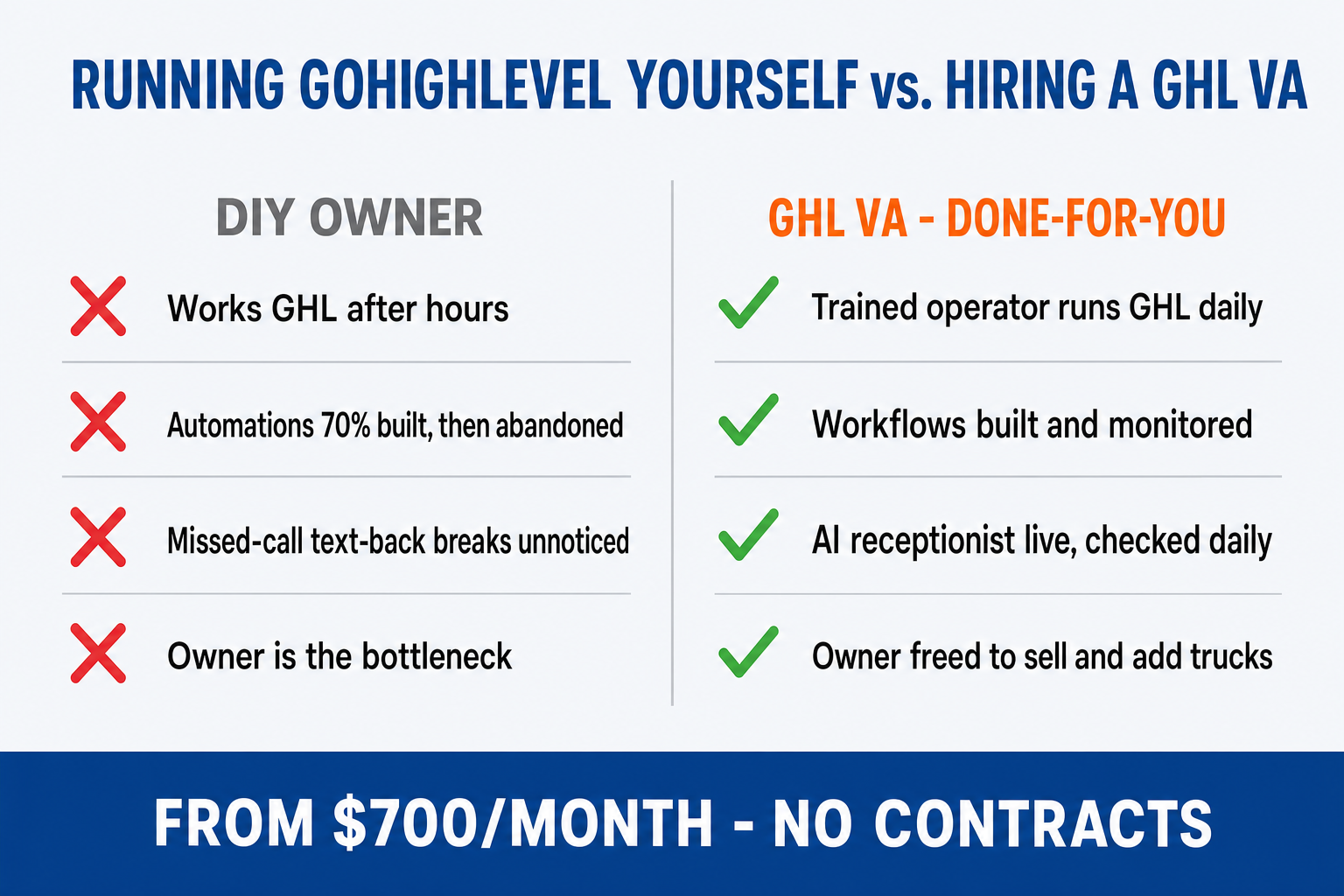
Running GoHighLevel yourself vs. a trained GHL VA
| What matters | DIY (owner runs GHL) | GHL VA (done-for-you) |
|---|---|---|
| Who does the work | The owner, after hours | A trained GHL operator, daily |
| Real hourly cost | Owner's rate (a booked install) | From ~$4-$9/hr on a monthly plan |
| Workflows actually finished | Usually 60-80%, then abandoned | Built, tested, and monitored |
| Missed-call text-back & AI receptionist | Often half-configured | Live and checked daily |
| Twilio / 10DLC / TCPA setup | Deferred until it breaks | Owned and kept compliant |
| What you get each week | A settings screen at 11 PM | A utilization report; your evenings back |
| Effect on scaling | Owner is the bottleneck | Owner freed to sell & add trucks |
The DIY column isn’t lazy — it’s an owner trying to do the right thing with the wrong hours. The VA column isn’t magic — it’s just the CRM being run by someone whose entire job is running it.
What a GHL VA costs — and when it pays back
Here’s where the math gets uncomfortable for the DIY case. A trained virtual assistant cuts labor cost 60-80% versus a comparable US hire (Wishup) — and that’s before you count benefits, which the U.S. Bureau of Labor Statistics puts at roughly 30% of total compensation on top of wages. You could hire a US office admin to run GHL for $45,000-$60,000 a year fully loaded, or a done-for-you GHL VA plan that runs the platform for a fraction of that.
Concretely: a Growth plan is $700/month for 4 hours a day — call it under $9 an hour for someone who does nothing but GoHighLevel. Set that against the leaks. One after-hours no-cool call caught by a properly-running AI receptionist is worth ~$1,200 in booked revenue (Invoca) — often more once it becomes an install. If a VA-run system recovers even one missed job a month that DIY would have dropped, the plan has paid for itself with three weeks to spare. Everything after that — the review engine finally sending, renewals going out on time, your evenings back — is upside.
The point isn’t that you can’t run GoHighLevel. Plenty of sharp owners can. The point is that the hour you spend running it is the single most expensive hour in your company, spent on the single cheapest kind of work — while the Houston heat sends you the exact calls a half-built system drops. Hand the platform to someone who runs it for a living, and put your own hours back where they earn: on the trucks, the estimates, and the growth.
FAQ
GHL VA for HVAC — common questions
What is a GoHighLevel VA?
A GoHighLevel VA is a trained virtual assistant who operates your GHL account for you — building and monitoring workflows, automations, AI chat and receptionist, review requests, pipelines, and CRM cleanup — so you don't have to learn or babysit the platform yourself. A niche VA also understands HVAC operations like dispatch, tune-ups, and seasonal demand.
How much does a GHL VA cost for an HVAC business?
Done-for-you GHL VA plans start at $700/month for 4 hours a day (roughly under $9/hour), with 8-hour-a-day plans at $1,250 and $1,500/month, plus a $20/hour pay-as-you-go option for one-off builds. That's typically 60-80% less than a comparable US hire once you count wages and benefits. See current GHL VA pricing for details.
Is it cheaper to just run GoHighLevel myself?
Only if your time is worth nothing. The subscription is $97-$497/month, but the real cost of DIY is the ~16 hours a week owners lose to admin, the automations that never get finished, and the after-hours calls that leak while you're in settings. Priced at what a booked HVAC install is worth, owner-hours are the most expensive labor in the company.
Will a GHL VA answer my customer phone calls?
A GHL VA builds and runs the systems that answer for you — the AI receptionist and missed-call text-back that catch after-hours calls — and can handle outbound follow-up. For live human phone answering specifically, that's a separate service, but the highest-ROI fix for missed calls is usually the automated AI receptionist a VA sets up inside GoHighLevel.
Do you work with HVAC shops in Houston and across Texas?
Yes. Our GHL VAs work with residential and light-commercial HVAC contractors across the U.S. and Canada, including the Houston and greater Texas market, where extreme summer heat makes a reliably-running CRM and after-hours receptionist especially valuable. The work is done remotely inside your GoHighLevel account.
What if the VA isn't a good fit?
Reputable providers replace a VA that isn't working out at no extra charge and run a probation window so you can cancel without penalty. Look for transparent, no-contract pricing and a clear VA policy before you commit.
About the author
Rachel Okonkwo is a GoHighLevel Automation Consultant based in Columbus, OH. She builds GoHighLevel workflows for home-service contractors and the agencies that white-label for them — review engines, maintenance-plan renewals, and AI receptionists across dozens of HVAC accounts — and is opinionated about which automations actually pay back inside 30 days. She writes the implementation-heavy pieces: pipelines, tags, triggers, and the snapshot install itself.