
It’s a 96°F afternoon in Orlando and a homeowner near Lake Nona just lost their AC. They pull out their phone, search “AC repair near me,” and do what nearly everyone does now: they skim the Google Map Pack, glance at the star ratings and the number of reviews, and tap the shop that looks the most trusted right now. Your tech may be better. Your price may be fairer. But if the shop above you has 240 recent reviews and you have 38 — most of them two years old — you never got the call.
Here’s the short version: automated review harvesting is the system that asks every customer for a Google review the moment a job is finished, routes happy customers to Google and unhappy ones to a private channel, and handles the replies — so your review count and rating climb on autopilot instead of depending on whether a busy owner remembered to ask. For an Orlando HVAC shop competing in a crowded, year-round cooling market, it’s one of the highest-return automations you can run — and it’s exactly what the review harvesting engine inside our snapshot is built to do. Let’s look at why the math is so lopsided.
On this page
- What is automated review harvesting?
- Why Google reviews decide who wins the Orlando HVAC call
- The Orlando reality: year-round demand, a crowded field
- Why “just ask for reviews” fails without automation
- How automated review harvesting actually works
- Speed and channel: why SMS beats email for review requests
- Responding to reviews is half the system
- Reviews now feed AI search, too
- Frequently asked questions
What is automated review harvesting?
Automated review harvesting is a workflow that automatically requests a review from every customer right after their job is completed, sends the request by the channel most likely to get a response (usually text), filters feedback so public reviews trend positive, and prompts a reply to every review — with no one on your team having to remember to do it. It replaces the “hey, if you get a minute, could you leave us a review?” that gets said on maybe one in ten jobs with a system that runs on every single one.
Think of it the way you think of a maintenance plan. You don’t rely on customers remembering to book a tune-up — you build the reminder into a system so it happens automatically. Review harvesting does the same thing for reputation: it turns “we should get more reviews” from a good intention into a machine that runs after every completed ticket, whether it’s July peak season or a slow Tuesday in the shoulder months.
Why Google reviews decide who wins the Orlando HVAC call
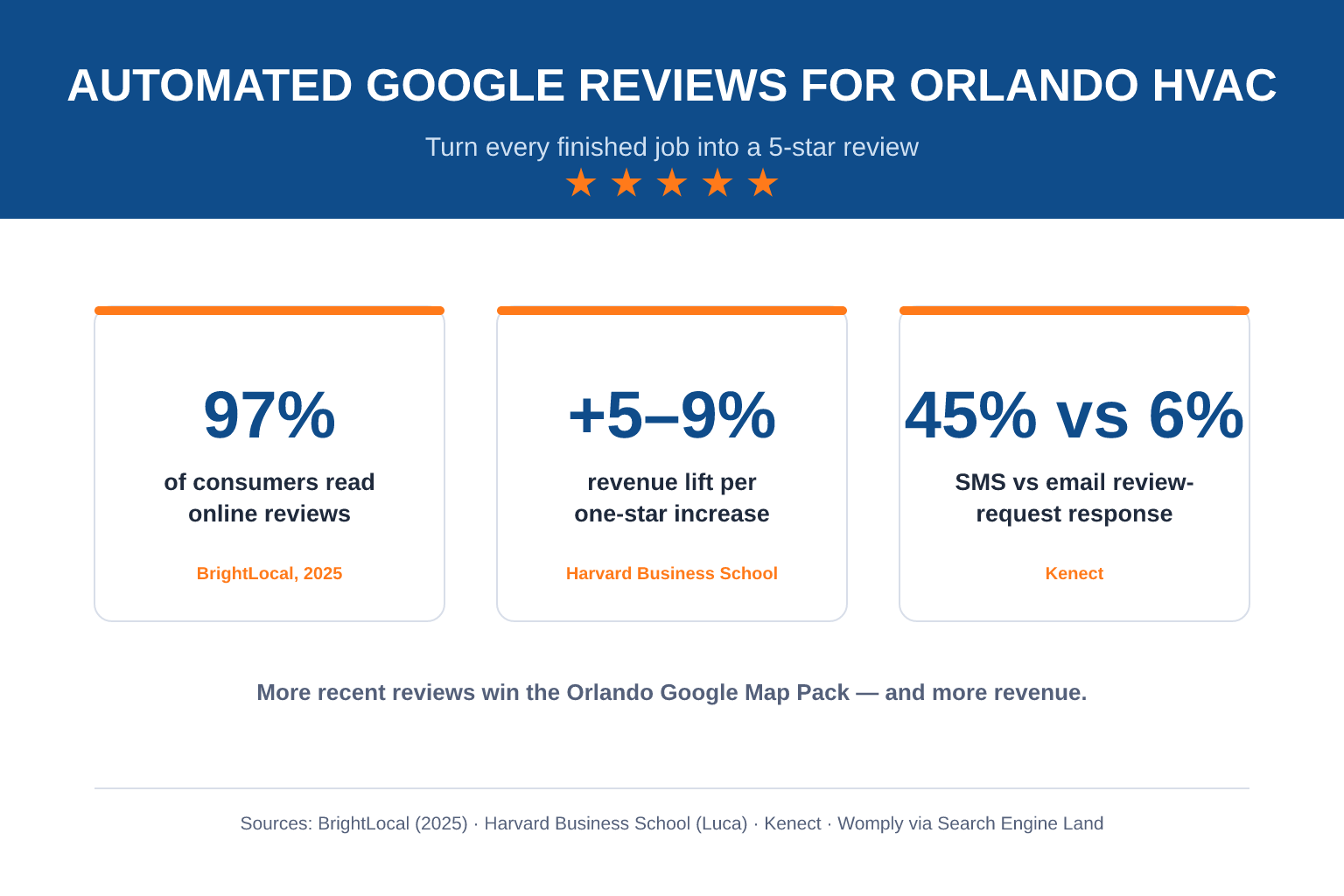
Start with how people actually choose a contractor. 97% of consumers read online reviews for local businesses, and trust has gotten harder to earn — only 42% now say they trust online reviews as much as a personal recommendation, down from 79% in 2020 (BrightLocal, 2025). Skeptical buyers don’t reward a handful of old five-stars; they reward a steady stream of recent, specific, replied-to reviews that read like real jobs.
That skepticism has a price tag. The most-cited research on the subject — Michael Luca’s Harvard Business School study — found that a one-star increase in rating produces a 5–9% increase in revenue (Harvard Business School). And volume matters as much as the number of stars. In a study of more than 200,000 small businesses, those with 9 or more recent reviews earned 52% more than average, and those with 25+ recent reviews earned 108% more (reported by Search Engine Land, 2019). More recent reviews, more revenue — close to a straight line.
Reviews don’t just persuade the buyer who finds you — they help decide who gets found at all. Review signals account for roughly a fifth of the ranking weight in Google’s local pack, and review recency and velocity now rank among the strongest factors (Whitespark, Local Search Ranking Factors). A shop that harvests fresh reviews every week climbs the Map Pack; a shop that lets its profile go stale slides down it — which is the whole game covered in our HVAC local SEO guide.
The Orlando reality: year-round demand, a crowded field
Orlando is a hard place to hide a weak reputation. Central Florida’s cooling season runs close to year-round — the region logs several thousand cooling degree days annually against only a few hundred heating degree days (NOAA Climate Prediction Center), which means AC calls never really stop and the phone rings for a new contractor almost every week of the year. That’s steady demand — and steady competition for it.
And there’s a lot of competition. Florida’s heating and air-conditioning contractor industry is worth roughly $9.8 billion, spread across more than 10,000 businesses statewide (IBISWorld). In a metro like Orlando, a homeowner searching “AC repair” gets a screen full of shops with strong-looking profiles. Home-service categories already run a high bar — HVAC and plumbing businesses average around 4.4 to 4.6 Google stars, above the ~4.1 all-industry average (ReplyOnTheFly, 2026). To stand out in that field you can’t just be good; your profile has to prove it, in volume, on a rolling basis.
The Orlando shops that win the Map Pack aren’t the ones with the best techs — they’re the ones whose reviews prove it, every week, without the owner lifting a finger. Reputation in a market this crowded is a systems problem, not a service problem.
Why “just ask for reviews” fails without automation
Every owner knows they should ask for reviews. The data says asking works: 69% of consumers who were asked to leave a review went on to leave one (BrightLocal, 2024). The problem isn’t that asking doesn’t work — it’s that a busy HVAC shop can’t ask consistently by hand. Here’s where the manual approach leaks:
- The tech forgets. After a hot attic and a long day, “leave us a review” is the last thing on a technician’s mind. Ask on one job in ten and you capture one review where you could have captured seven.
- The timing is wrong. A review request that goes out three days later, by email, lands in a spam folder. The window when a customer is happiest — right after the AC kicks back on — closes fast.
- Recency decays. Reviews aren’t a trophy you win once. Only about 7% of consumers say review recency is irrelevant, while roughly half say a review from the last month makes them feel positive about a business (BrightLocal). Last summer’s reviews don’t win this summer’s calls.
- One bad day goes public. Without a system to intercept an unhappy customer before they post, a single rough job can drop your public rating — and cost you that 5–9% per star in reverse.
How automated review harvesting actually works
The fix is to take the ask off your team’s plate entirely and wire it into the job itself. When a ticket is marked complete in your CRM, the system does the rest. Here’s the flow the review harvesting automation runs:
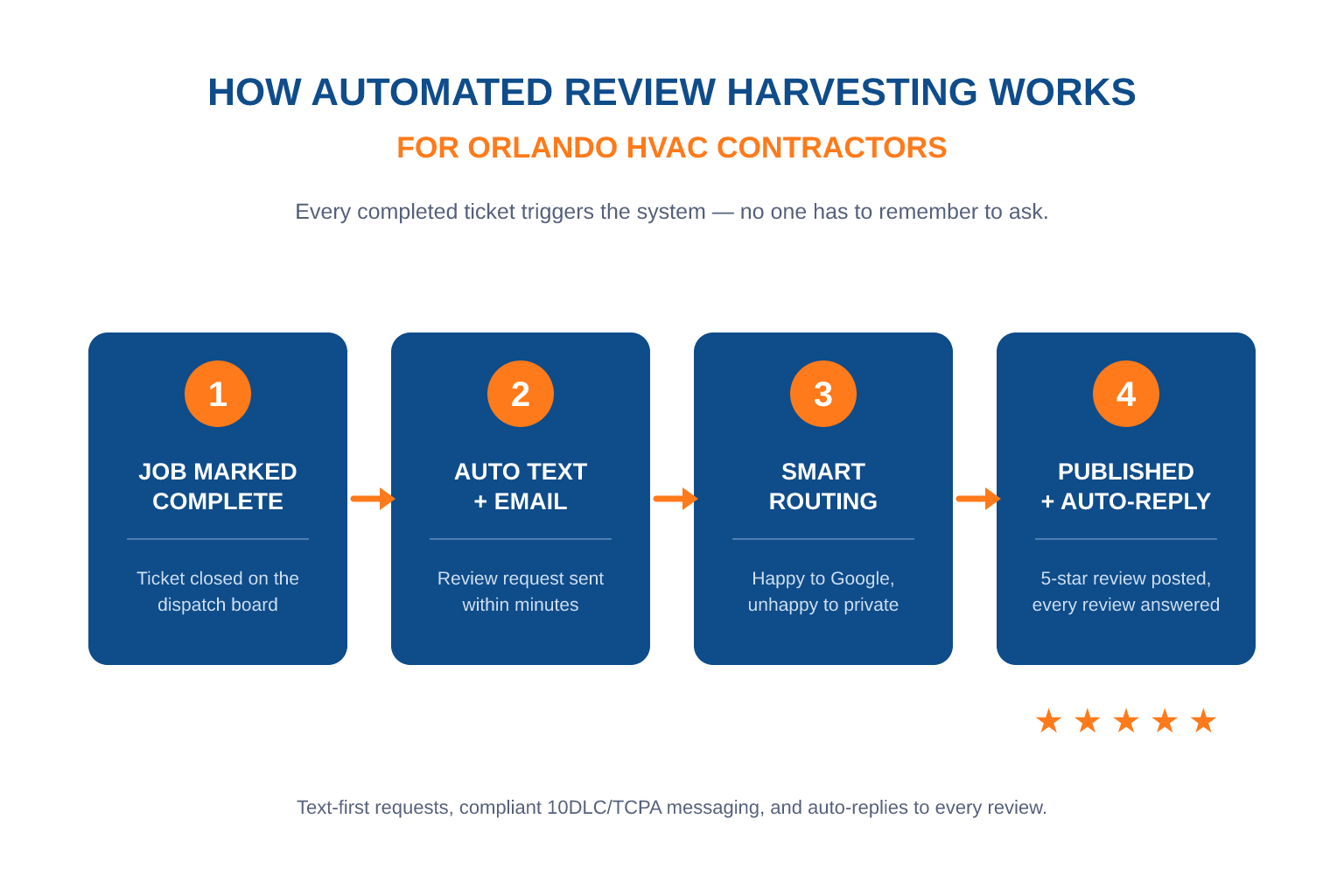
- Job marked complete. The tech closes the ticket on the dispatch board. That single action is the trigger — no separate step to remember.
- Automatic request within minutes. The customer gets a short, friendly text (and a backup email) with a one-tap link to your Google profile, while the good experience is still fresh.
- Smart routing. Delighted customers go straight to Google. If someone signals they’re unhappy, the system routes them to a private feedback form first — so you hear about it and can make it right before it becomes a public one-star.
- Published and answered. New five-star reviews post to your profile, and the system prompts (or auto-drafts) a reply to every review, positive and negative — which matters more than most owners realize (next section).
The result is a review engine that runs on every completed job, in peak season and out, without adding a task to anyone’s day. Pair it with missed-call text-back and after-hours booking and the same completed job feeds both your revenue and your reputation.
Speed and channel: why SMS beats email for review requests
The single biggest lever in review harvesting is how you ask. Email review requests mostly die in the inbox; text messages get read and answered. According to Kenect, SMS review requests see around a 45% response rate versus roughly 6% for email, and about 98% of texts are opened — most within minutes — against 20–30% for email.
That gap is why a good review-harvesting system leads with a text and uses email only as a fallback. It’s also why the whole thing has to be built on compliant messaging — texting customers means proper 10DLC registration and TCPA-compliant opt-in, which we break down in the 10DLC + TCPA guide for HVAC. Done right, the text goes out in minutes, the customer taps once, and the review is live before your tech has pulled out of the driveway.
Responding to reviews is half the system
Getting reviews is only half of reputation; answering them is the other half, and it moves the needle more than most owners expect. 88% of consumers would use a business that responds to all of its reviews, versus just 47% for a business that responds to none (BrightLocal, 2024). Nearly nine in ten consumers now expect owners to respond to both positive and negative reviews (BrightLocal, 2025).
Speed matters here too. 53% of customers expect a business to respond to a negative review within a week, yet 63% say a company they reviewed never responded at all (ReviewTrackers). That’s a wide-open lane: a shop that replies quickly and professionally to every review — thanking the happy customers, calmly addressing the unhappy ones — looks dramatically more trustworthy than the Orlando competitor whose reviews sit unanswered. Automation handles the prompt and can draft the reply; you just approve it. Pair it with Google Business Profile reply automation and the whole review conversation runs itself.
The Orlando HVAC shop's reputation, before and after automation
Techs remember to ask on ~1 in 10 jobs. Requests go out days later by email and get ignored. Reviews are sparse and aging. A bad job posts publicly with no warning. Replies are rare. The shop slides down the Map Pack as competitors climb.
Every completed ticket triggers a text in minutes. Happy customers land on Google; unhappy ones are caught privately first. Fresh five-star reviews post weekly, every one gets a reply, and the profile climbs the Map Pack on its own.
Reviews now feed AI search, too
There’s a newer reason review harvesting matters in 2026: reviews don’t just influence Google’s blue-link results and Map Pack — they feed the AI answers more homeowners now rely on. Google’s AI Overviews and tools like ChatGPT and Perplexity lean on Google Business Profile signals — review volume, recency, sentiment, and how consistently a business responds — when deciding which local companies to surface and recommend (Search Engine Journal).
In practice, that means the same fresh-review habit that wins the Map Pack also makes your shop more likely to be the one an AI assistant names when an Orlando homeowner asks it for “a reliable AC repair company near me.” A stale profile is invisible to that layer of search entirely. If you want the full picture on getting surfaced by AI answer engines, we cover it in how HVAC contractors get found in AI search — and review harvesting is the foundation of it.
What it’s worth to an Orlando shop
Put the pieces together and the return is hard to argue with. Each finished job already costs you money to generate — the ad, the lead, the truck roll. Automated review harvesting extracts a second asset from that same job: a fresh, public, ranking-boosting review, captured with zero added labor. Stack that across every ticket, all year, in a market where cooling demand never quits, and you’re compounding both your Map Pack position and — per the Harvard and Womply data — your revenue, month over month.
The alternative isn’t “no reviews.” It’s someone else’s reviews winning the calls you paid to earn. In a field of 10,000-plus Florida contractors, the shop that turns every job into a review isn’t working harder than you — it just built the system once and let it run.
Frequently asked questions
Automated review harvesting for HVAC — common questions
What is automated review harvesting for an HVAC business?
It's an automated workflow that requests a Google review from every customer right after their job is completed, sends the request by text (with email as backup), routes happy customers to your public Google profile and unhappy ones to a private feedback form first, and prompts a reply to every review. It runs off your CRM, so no one on your team has to remember to ask.
How many more reviews will automation actually get me?
It depends on job volume, but the lever is consistency. Asking works — 69% of people who are asked leave a review (BrightLocal, 2024) — and a busy shop that asks on one job in ten by hand can capture several times more by asking automatically on every completed ticket. SMS requests alone see roughly a 45% response rate versus about 6% for email (Kenect).
Is it against Google's rules to route unhappy customers away from Google?
You cannot 'review-gate' — selectively soliciting only positive reviews while blocking negative ones violates Google's policies. A compliant system asks every customer for feedback and makes leaving a public review available to all of them; it simply gives an unhappy customer an easy private channel to reach you first. The goal is to resolve problems quickly, not to hide them. A done-for-you setup keeps you on the right side of that line.
Do I need to text customers, and is that TCPA-compliant?
Text dramatically outperforms email for review requests, so yes, SMS should lead. It has to be built on proper 10DLC registration and TCPA-compliant opt-in and opt-out handling. Our snapshot ships that compliance wiring in — see our 10DLC + TCPA guide for the details.
How do reviews help me rank in the Orlando Google Map Pack?
Review signals make up roughly a fifth of local-pack ranking weight, and review recency and velocity are among the strongest factors (Whitespark). A steady flow of fresh reviews lifts your Map Pack position over time, while a stale profile slides down. See our HVAC local SEO guide for the full ranking picture.
Does this work for HVAC shops outside Orlando?
Yes. The automation is the same for any residential or light-commercial HVAC contractor in the U.S. or Canada — Orlando is just a good example of a crowded, year-round-demand market where reputation compounds fast. The review harvesting engine is part of our done-for-you HVAC snapshot.
About the author
Rachel Okonkwo is a GoHighLevel Automation Consultant based in Columbus, OH. She builds GoHighLevel workflows for home-service contractors and the agencies that white-label for them — review engines, maintenance-plan renewals, and AI receptionists across dozens of HVAC accounts — and is opinionated about which automations actually pay back inside 30 days. She writes the implementation-heavy pieces: pipelines, tags, triggers, and the snapshot install itself.